On a recent episode of the podcast, Why Would She WANT to Have Sex with You?, I handed men a question most of us have never once asked, and I taught half of a map. The half you got was about sequence: for a lot of men, desire leads, and for many women, much of the time, desire trails connection. And at the end I told you there was a second question underneath the whole thing, one I'd write up in full. This is that writeup.
The second question is this: what is your wanting actually seeking?
Sit with that for a second, because the answer sorts almost everything that goes wrong in a couple's sex life.
Where the popular map breaks
You've probably heard desire described as spontaneous or responsive. Emily Nagoski's book Come As You Are made that language popular, and the book is genuinely great. But the language has a crack in it. It implies desire is either self-generated or triggered from outside, and the moment you lean on that line, it breaks. Almost no desire is self-generated. A man "spontaneously" wants because a woman is in the room. That's outside input too. So the internal-versus-external line ends up sorting nothing, and couples using it stay confused about the exact thing it was supposed to explain.
Two different variables actually do the sorting.
The first is sequence. Does the wanting arrive before the encounter is underway, or through it? Wanting leads, or wanting trails. This is the axis I taught on the podcast, and it comes from Rosemary Basson's research on the circular model of sexual response. One note that matters here: "underway" means more than physical. For the connection-gated pole, the engagement that leads is usually emotional, being met and felt before anything physical begins.
The second is aim. Is the wanting seeking release, where the target is basically interchangeable? Or is it seeking union with one specific person? I call these discharge and eros.
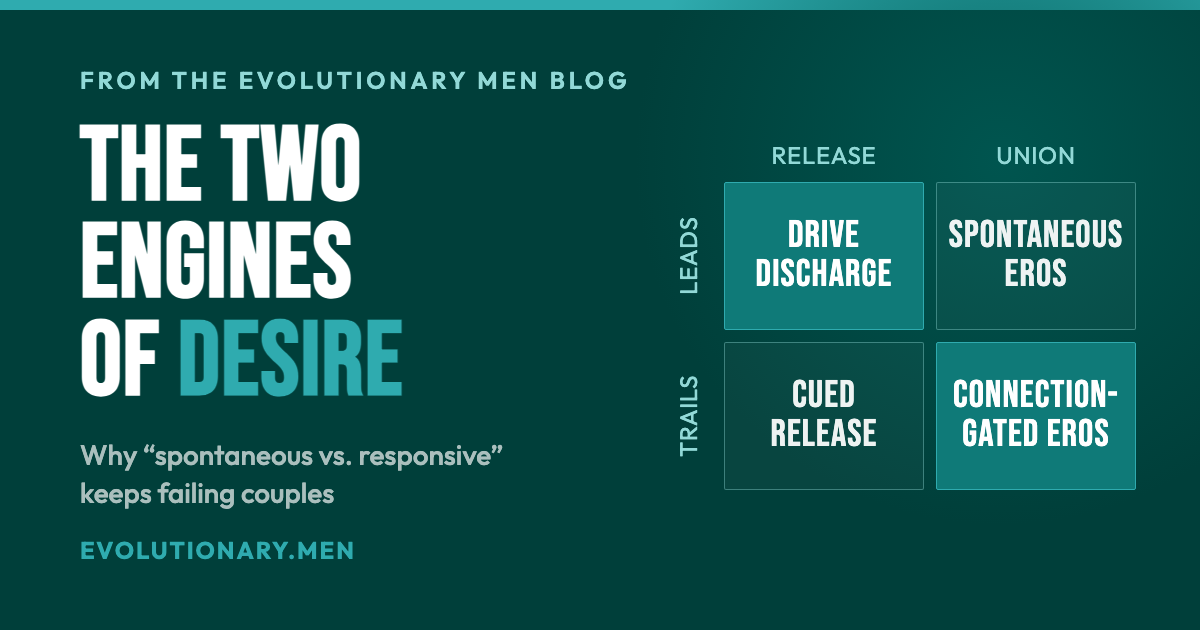
Cross the two axes and you get four engines:
Drive discharge. The wanting shows up first, and it's about release. You know this one. It's been a brutal week, there's a charge in your body that wants OUT, and if you're honest, almost anything would do the job. Porn would do it. Your own hand would do it. A partner you've barely spoken to all day would do it. It runs like hunger: it builds whether or not anyone's cooking.
Spontaneous eros. The wanting shows up first, and it's about her. She walks through the kitchen in your old t-shirt, or her name just crosses your mind in the middle of a workday, and you want HER. Nobody else would scratch it, because nobody else is her.
Stimulation-cued release. Nothing's stirring until something wakes it up. An image, a scene, a stray touch, and now the engine's running. But it's still about release, and the target is still basically anyone.
Connection-gated eros. Nothing's stirring at first here either. Then comes the real conversation, the laughing fit on the couch, the twenty minutes of actually being together, and somewhere inside that, the wanting arrives, and it's for this person and no one else. This is the engine most women get reduced to. It's also the one most men don't know they have.
Here's why one spectrum could never hold this. Drive discharge and connection-gated eros feel like opposite planets, and they are, release versus union, leading versus trailing. But both look "externally triggered" from the outside, so the old frame kept filing them in the same drawer. Put them on the grid and they land in opposite corners, which is exactly where they belong.
On the podcast I gave you the question that lives at the seam between these engines: when you reach for her, which engine is doing the knocking? Discharge wearing the costume of eros, "I want you" spoken when the true engine is "I want release," is where a huge amount of the quiet injury in long relationships sits. I told my own 9pm version of that story on the episode, and I won't repeat the whole confession here, but I earned every bit of the denial I got.
She has the same four engines
Now for the half I didn't teach on air.
The stereotype hands him the drive engines and hands her the connection engine. That's a cultural reading, and it's wrong about bodies. She runs all four. She has a discharge engine: stressed, wound up, wanting to get off, and in that state you are closer to interchangeable than either of you expects. She has spontaneous eros: she thinks of you and wants you by name, no runway needed. She has the cued engine and the gated engine too. The gated corner is just the one culture reduces her to.
Two things follow from this, and each one rescues a different kind of misreading.
First, when she IS running connection-gated, her wanting will not show up until she's already in it. She can be neutral at the start and fully alive twenty minutes in, and neither state is the fake one. If she keeps auditioning herself for spontaneous craving, waiting to feel it before she'll begin, she'll conclude she's broken. The move, and Nagoski teaches a version of this, is to agree to start, and trust arousal to summon the wanting. That single reframe rescues more bedrooms than any technique I know.
Second, when she reaches from her discharge engine, that is not evidence she's stopped loving you. Men who've absorbed the stereotype tend to do one of two things with her stress-driven reach: over-read it as deep romantic eros, or feel obscurely used when they sense it was about release. Neither response is needed. She has a body. Tension builds in it. Welcome to the club.
And worth saying plainly: in plenty of couples, the higher-drive partner is her. Our culture has no script for that, so both people quietly pathologize it. The grid doesn't care who runs hotter.
What it's like on the receiving end
This is the piece that changed how I teach this, because it's the piece the man's-eye view can't see.
When you reach for her from eros, she is wanted as herself. The specificity is the entire gift.
When you reach from discharge, the body she lives in is doing a job your hand could do. Some part of her registers that, even with no words for it, even when you have no idea it's showing.
And here's where most teaching goes wrong by turning this into a morality lesson. Being wanted from pure drive is not automatically a wound. Plenty of women want, at least sometimes, to be desired urgently, taken, wanted bodily with the thinking switched off. Drive-wanting can land as hot and deeply affirming. The injury, when there is one, is one of three specific things:
The counterfeit. Discharge sold as eros. Your mouth said "you," your engine meant "release." Her body feels the mismatch before her mind can name it, and because she can't point to anything, the lie corrodes quietly for years.
The monoculture. Discharge as the only engine that ever reaches for her, so she is never once wanted as herself. Any single instance might be fine. A whole diet of it erases her.
The mistiming. Your discharge arrives before her context-key has been turned. Your drive is up, her runway was never laid, and the reach meets a cold start. She declines and you read rejection, or she complies from duty and the interchangeability she felt gets confirmed. Both of you walk away hurt, and neither of you is the villain.
Keep the honesty, the balance, and the timing, and the very same act that could have landed as erasure lands as heat.
The asymmetry underneath the standard fight
One more distortion to name, because naming it out loud is often the first relief a couple feels. Culture validates his discharge as "real desire" and files her gated pattern as "low libido, something to fix." Both readings are wrong. He starts believing his ready drive is the benchmark and her slower gate is a deficiency. She starts believing his easy wanting proves he's shallow, or that she's defective. They're running different engines under a culture that ranked them. Nobody in that fight is broken.
The repair
Five moves, biggest first:
1. Name your own engine first, to yourself. When you reach, which one is actually running? Most people have never once asked.
2. Consent to the engine, not just the act. "I'm wound up and I want you" is workable, and a partner can give a full, glad yes to exactly that. Being recruited into discharge under the label of eros is a different event entirely. Honesty about the engine is what makes the yes real.
3. Turn the context-key on its own schedule, decoupled from the ask. You don't build her runway by asking for sex. You build it with the day's worth of contact, safety, and being seen. The key gets turned hours before, or not at all.
4. Stop counterfeiting. Let discharge be discharge and eros be eros. Both can be offered and both can be wanted. Only the lie has to go.
5. Hold the closeness paradox. Connection opens her gate, and yet total fusion can flatten eros, because wanting needs some distance to reach across. Esther Perel built a whole book, Mating in Captivity, around that tension. Closeness opens the gate. Merger dims the fire. A couple has to hold both.
And the questions to carry out of this, one for each seat. For him: when you reach for her, which engine is running, and does she know? For her: when he reaches, do you actually know which engine it is, or are you guessing? And for each of you about yourself: which engines run in me, and does my partner know I have more than one?
One last thing, so the grid doesn't harden into boxes. These are states, not types. You move between engines with stress, context, and season of life, and so does she. The gendering in this piece is my clientele and this culture's script, and it is not a law about bodies. Any engine runs in anyone.
The map is not the teaching. The teaching is that desire has more than one engine in each of you, that the engines wear each other's costumes, and that most of what you've been calling a desire problem is a labeling problem you were never given words for.
So tonight, before anything else: which engine is running in you, and does she know?