
THE COMPLETE GUIDE
WHAT IS A MEN'S GROUP?
A men's group is a place where men gather, slow down, and pay real attention to each other. Not a lecture. Not therapy. A room where you get to practice being honest about what's actually happening in your life.
WHY MEN NEED THIS
THE LONE WOLF IS THE ONE THAT WAS KICKED OUT OF THE PACK
There's a romantic idea a lot of us men carry. The lone wolf. The rugged individual. The guy who handles everything on his own and never needs anyone. It sounds strong. It sounds free.
But in the actual wilderness, the wolf that's alone is the one that was ostracized from its community. And those wolves don't live as long.
The same is true for us. I've worked with hundreds of men since 2018, and I can tell you: the pattern that shows up most is isolation. Not the dramatic kind. The quiet kind. You're surrounded by people, you have friends, maybe a partner, maybe kids. But when something real is happening inside you, there's nobody to call. Nobody who actually knows what's going on beneath the surface.
You sit across from your wife at dinner and have nothing to say. Again. You go through the motions at work, come home, collapse on the couch, and zone out. Not because you're lazy, but because you're empty. You've been holding so much in your body all day that there's nothing left to give.
Most men connect through what I call triangulation. Instead of facing each other and talking about what's actually going on, most masculine culture focuses on relating through a third thing. Sports. Women. Money. Working on cars. The focus and orientation has to be on that third thing. You can even see it physically in where men face. They're not facing each other. They're facing out. And our pain gets routed through those external things. Standing right next to someone. And being totally missed.
This isn't because men don't want connection. It's because we were never taught how to create it with each other. The mythology we inherited says: handle it yourself. Don't burden anyone. Be the rock. And for a while, that story works well enough. It gets us through school, into careers, into families. But the cost shows up over time. In our health. In our marriages. In the flatness we feel where aliveness used to be.
Research shows that men who strongly identify with traditional stoic masculine ideas are doubly at risk for suicide. Feeling isolated or alone is just as dangerous as smoking a pack of cigarettes a day. That's the actual impact on our hearts and our well-being. It's not Navy SEAL. It's Navy SEALs. The plural matters. The most capable, resilient, effective men on the planet operate in teams. They train together. They depend on each other. The lone wolf mythology isn't just emotionally costly. It's factually wrong.
A men's group is one of the most direct ways to break this pattern. Not a therapy group. Not a book club. A place where men practice the hardest and most important skills of being alive: feeling what's actually happening inside them, saying what's true, and staying connected even when it's uncomfortable.
BEYOND THE STEREOTYPES
WHAT A MEN'S GROUP ACTUALLY IS
When most people hear "men's group," they picture something between a therapy circle and a motivational seminar. It's neither.
A men's group is a small, consistent group of men (usually 6 to 10) who meet regularly, typically every other week, to pay real attention to each other. There are agreements about confidentiality, honesty, and showing up. There's structure, because without structure, men default to what we do best: float up and talk about things. We report. We stay at the surface.
The structure is there to help us go deeper. What's the schedule for the night? Where are we putting our attention, and why? Because if we don't have that, we drift.
In a good men's group, you practice slowing down enough to notice what's actually happening in your body. You say the thing you've been carrying for weeks. And other men listen, not to fix you, but to see you. Sometimes they reflect back what they notice. Sometimes they challenge you. Sometimes they just sit with you in something hard.
It's not about becoming a clone or parroting group-think. By joining the group, you actually become more yourself. A good men's group creates a safe space for you to come into contact with your deepest truth.
THE THREE DOORS
THREE REASONS MEN JOIN A MEN'S GROUP
In my experience, men walk through one of three doors when they find a group. These don't always come in order, but there's often a natural progression. For the longer case, I wrote five reasons to join a men's group years ago.
Pain and Healing
Something happened. A divorce, a health crisis, a loss. Or maybe nothing dramatic, just a slow realization that the numbness has gotten too heavy. These men need a safe place to feel the feelings they've been holding in their bodies as physical tension. Grief, anger, regret. They want to stop the bleeding and find solid ground again.
Challenge and Accountability
They're not on the ground bleeding, but there's a deep sense of "is this it?" They're living the script and yet feel empty inside. They know they have more to give. They want someone to help them keep their eye on the ball, give honest feedback, and call them forward. Like working out with a partner instead of alone.
Just Being
This is the door most men don't expect. After the healing and the growth, there's something deeper: the practice of simply being present with other men. No agenda, no performance. Just resting in the experience of being known. This is where the group becomes part of your life's foundation, not a fix but a practice.
Some things aren't meant to be felt alone. A men's group gives you a place to be met in the worst of it, without being fixed, without being judged, without being told it'll be okay when you're not sure it will be.
This is what I call carefrontation: confrontation that comes from genuine care. Every man secretly wants that moment when another guy looks him in the eyes and says, I love you and you're full of shit right now. You can't get that from a podcast. You can't get that from a book. You need other men.
I've been on the receiving end many times. I've had men look at me and say, hey man, I'm just not feeling you as very grounded right now. You feel scattered. My first reaction is to defend. But I've gotten better at just noticing that yearning and taking a deep breath. And that feedback, when I let it roll through me, has more often than not been correct. That's what a real container produces. Men who care enough about you to name what they see. And a version of you that has practiced enough to actually receive it.
The deeper move here is calling forth even more than calling out. I see you brother. I see your heart. I see what you're capable of. And what I'm experiencing right now is not that. I love you so much I'm not going to stand for it. That distinction changes everything. Calling out shames. Calling forth invites a man into the fullest version of himself. Both require courage. But only one builds the kind of trust that holds a group together for years.
The "just to be" category tends to emerge after some time in the work. Men who started in crisis or ambition discover something quieter underneath: the simple nutrient of being known. Brotherhood as the missing nutrient that most men didn't know they were starved for.
These three reasons aren't fixed categories. A man who started in acute pain finds himself challenging others six months later. A man who came for accountability discovers he's grieving something he didn't know he was carrying. The group holds all of it. That's what a good container does.
THE REAL PAYOFF
WHAT A MEN'S GROUP GIVES YOU
Emotional Regulation
When we're not feeling our emotions, we're holding them in our bodies as tension. That takes energy. A men's group gives you a safe place to learn to feel, to name what's happening, and to release what you've been carrying. Most men I work with report having more energy for their actual lives within weeks.
Better Relationships
The skills you practice in a men's group transfer directly to your intimate relationship and your parenting. Learning to listen without fixing, to stay present when things get uncomfortable, to say what's true even when it's hard. Your partner will notice the difference.
Accountability That Works
On more than one occasion, the only reason I made any movement on things I cared deeply about was because I had put it out there in my men's group. Knowing that next meeting is coming creates a productive pressure that gets things done. Groups have breakthroughs in similar timing. It's kind of magical.
You Accomplish More
Knowing you have a team of men behind you emboldens you to take bigger risks. You move your life forward in more bold ways because you know there's a net. You can only fall so far. When we're doing the rugged individual thing, we play it safe and then beat ourselves up for never doing enough.
Masculinity as Transmission
Masculinity isn't a concept you read about. It's something you feel in person, a transmission that passes between men. Before the industrial revolution, boys spent their days alongside older men and absorbed this naturally. We've lost that. A men's group restores it. You get to experience and transmit what healthy masculinity actually feels like.
"Part of my mission statement is every man should be in a men's group. If every man was in a men's group, I think the world would get a lot better. A lot of the awful things we see men do can be traced to isolation, loneliness, not having another man look them in the eye and say: I believe in you. You can do better than this."
Jason Lange, Founder of Evolutionary Men
INSIDE THE ROOM
WHAT ACTUALLY HAPPENS IN A MEN'S GROUP
Every group is different, but good ones share common elements. Here's what a typical meeting looks like in the groups I run:
Arrival and grounding. We start by getting out of our heads and into our bodies. A few minutes of breathing or simply noticing what's happening physically. This sounds small, but for most men, it's the first time all week they've actually paused.
Check-in. Each man shares where he's at. Not a report on his week. Where he's at right now, in his body, emotionally. This is where the honesty starts.
Deep work. One or two men take the floor for focused attention. This might look like a man naming something he's been avoiding, or working through a conflict he had with his partner, or sitting with grief he didn't know was there. The group holds space, asks questions, reflects back what they see.
I literally just get through the door. Boom. It all drops out. All the feelings. All the emotions. And I don't have to do anything. Nothing has to change yet. The guys are just with me. With me in that. Sometimes the disorientation runs so deep you don't know what comes next. That's where masculine support really comes in. Not advice. Not problem-solving. Just one man saying, hey brother, I feel you. I hear you. That sounds really tough. What do you think needs to happen? That kind of presence is the foundation of what men's work actually delivers.
Feedback and challenges. This is the part most men secretly want but are afraid to ask for. Honest, loving feedback. "Hey, how you're treating that woman, that's not good, man. Are you in? Are you out? Because I know you're better than this." Most guys are actually longing for someone to give them honest feedback from a caring place.
Integration. What are you taking from tonight? What's one thing you're going to do before we meet again? This is where the accountability thread starts.
The beauty of a men's group compared to a retreat or a workshop is that it's woven into your actual life. My experience is that it's like a heartbeat. Every other week, I'm dropping in with my men, really getting a sense of where I'm at. And there's no escape. It's based on what's happened in my life the last ten days. That's where the real changes stick.
THE CAPACITY THAT CHANGES EVERYTHING
CONFRONTATIONAL TOLERANCE
One of the most valuable things a men's group builds is your capacity for confrontational tolerance. This doesn't mean getting into fights. It means something much harder and much more useful.
Confrontational tolerance is the ability to stay connected to another person even when you disagree. It means you believe or want one thing, another man believes or wants something different, and you can stay present as humans in that process. You don't collapse. You don't posture. You don't withdraw. You hold your ground and you stay in relationship.
This is a skill men need now more than ever, particularly as our culture moves toward a frictionless one. Every app, every service, every algorithm is designed to remove friction from your life. Easy transactions. Curated feeds. People who think exactly like you do. And it's making us fragile. When real conflict shows up, in a marriage, in a business, with a friend, most men either blow up or shut down. There's no middle.
A men's group is where you build that middle. You practice having hard conversations while staying connected. You learn that disagreement doesn't mean disconnection. You discover that you can hold your position, feel the heat of friction, and still love the man sitting across from you. That capacity transfers directly into your marriage, your parenting, your leadership, and every other relationship that matters.
NOT ALL GROUPS ARE THE SAME
DIFFERENT TYPES OF MEN'S GROUPS
The men's work world has grown a lot in the last decade. There are now many different approaches, and they're not all the same. Here's a rough map:
Accountability and goal-setting groups. These focus on productivity, career, and life targets. Think mastermind-style, with regular check-ins on progress. They're valuable, but they tend to stay cognitive.
Support and processing groups. These lean toward emotional support, often resembling group therapy. Great for men in crisis or early in their growth. The risk is they can stay in the "healing" mode indefinitely without building capacity.
Embodiment and depth groups. These integrate body awareness, shadow work, and relational practice. They work with what's happening in the room, in real time, between the men. This is where I spend most of my time. It's where I've seen the deepest, most lasting changes.
Peer-led groups. Run by the members themselves, with rotating facilitation. These can be powerful if the men have enough training and structure. Without it, they drift into reporting. A peer-led group can't be taken from you. Nobody can cancel it. Nobody can raise the price. Nobody can dissolve it because they moved on to other things. It's yours. And the ownership changes the dynamic completely. When you co-create a group rather than consume one, you bring a different level of commitment. The investment comes from inside.
My own LA group has met every other Monday since 2014. Eight guys. Four hours a month. No facilitator. No fee. They rotate who holds the structure, and we've navigated careers, divorces, births, deaths, cross-country moves, and a global pandemic together. One group I was part of before that met every other Wednesday for fourteen years. As one member put it: "We're to the grave." That kind of investment compounds over time in ways no subscription model can replicate. If you want to start your own peer group, I teach men how to do exactly that through our Men's Group Experience.
Facilitated groups. Led by a trained facilitator who holds the container, tracks the energy, and guides the process. This is what I offer through Evolutionary Men. It lets men focus on their own work instead of managing the group dynamics.
The decentralized model is what I've been building toward throughout my career. The organization provides the training, the framework, and the initial container, then hands the keys to the men themselves. It takes men from consuming someone else's group to co-creating the group they want. And it scales in a way that centralized models never can, because every man who learns to hold space becomes a potential leader of his own circle. The men become, as Dr. Luke Adler puts it, "midwives of the soul of the group." Nobody owns it. Nobody runs it from the top. Each man holds a piece of the container, and the group itself becomes the teacher.
There's no single right answer. The best group is one you'll actually attend consistently, with agreements you trust and men who will be honest with you.
TWENTY YEARS IN THE CIRCLE
STORIES FROM THE CIRCLE
The theory of men's groups is useful. But the truth of them lives in specific moments. I've been sitting in men's groups for over two decades, and certain moments stand out across all those years.
There was the night I asked the entire group to pile on top of me. Physically. Bodies stacked. And instead of feeling crushed, it as one of the most blissful experiences of my life. I'd been numb and carrying tension had been carrying weight my whole life. The pressure opened me.
I went through a devastating breakup and showed up to group unable to speak. I didn't need to speak. The guys just sat with me. No advice. No silver linings. Just presence. That was the night I started to come back to myself.
After one particularly deep session, a snowball fight erupted spontaneously. Grown men in the dark, laughing and hurling snow at each other. No one planned it. The intensity of the work needed somewhere to go, and it went into play. Men need that too.
I brought a short film I'd made years earlier to my group. I had never shown it to anyone because the vulnerability of it terrified me. The guys watched it and supported me in one of my biggest creations of my life.
When one of my guys was caring for a family member at the hospital, we circled up in the dining hall. We ran the meeting just like normal, but close to him so he could be close to his family. Same check-in. Same honesty. Same depth. Just in a different room.
When COVID hit, my LA group shifted to meeting in backyards. First with masks, then with distance. That gave me the minimum viable dose of connection with people in person. It gave me a resiliency to get through that. Had that happened a decade earlier, before I had a wife and kids and my men's group, it would have been brutal. Two meetings a month. That was enough to hold me together through the worst collective disruption of our lifetime. That's the compounding value of this work over years.
This work has changed my life. Helped me navigate moving to a new city. Leaving a relationship that was comfortable but not right. The first years of my marriage. The challenges of becoming a father and unexpected twists in the birth of my daughter. Not a single one of those transitions is something a man should face alone. Every one of them was held by other men.
These moments aren't dramatic in the way movies portray male bonding. No one punched through a wall or had a screaming breakthrough. The power is in the consistency. In showing up week after week, year after year, and building something that can hold anything. Joy, grief, fear, rage, tenderness, celebration. All of it. That's what a men's group becomes over time.
GETTING STARTED
HOW TO FIND A MEN'S GROUP
If you're looking for a men's group, here's what to consider.
Search locally. Start with a search for men's groups in your city. Many operate through word of mouth and don't advertise broadly. Check community boards, counseling centers, churches, and yoga studios. Ask your therapist if they know of any. The ManKind Project runs open groups in many cities (called "I-Groups"). EVRYMAN offers online and in-person options. Local facilitators often run groups that aren't affiliated with any national organization.
Try online. If you're in a location without local options, or if you want to start with a lower barrier, online men's groups are increasingly common and can be surprisingly powerful. The eye contact through a screen is less than in person, but the honesty, the accountability, and the connection still show up.
Start your own. This might sound intimidating, but hear this: the most powerful men's groups in my life have been the ones that men started themselves. You don't need a certification. You don't need a manual. You need three to six men who are willing to show up consistently and tell the truth.
Here's a simple structure to start with. Meet weekly or biweekly. Begin with a check-in: each man shares what's alive for him, three to five minutes each. Go around again for deeper sharing: what's the hardest thing you're facing right now? Close with commitments: each man names one thing he'll do before the next meeting. Rotate who holds the structure. Keep it going for at least twelve weeks before deciding if it's working. Most groups need that long to build enough trust for the real work to begin.
What to look for. Whether you join an existing group or start your own, a few things matter more than anything else.
Consistency. A group that meets sporadically builds nothing. Weekly or biweekly, same time, same place. Treat it like training.
Confidentiality. What's shared in the group stays in the group. Period. Without this, trust never forms, and without trust, depth is impossible.
Challenge and support. The best groups hold both. They meet you with love and they refuse to let you stay comfortable in your patterns. If a group is all support with no challenge, it becomes comfortable but doesn't grow. If it's all challenge with no support, it becomes harsh and men stop showing up.
Shared leadership. Over time, the healthiest groups are ones where leadership rotates. Every man eventually takes a turn holding the space. That's where real growth happens. Not in consuming a group, but in helping create one.
No spam. Unsubscribe anytime.
THE BODY PIECE
WHY THE BODY MATTERS
There's a bundle of nerves that runs down the center of your body called the vagus nerve. It's the information superhighway between your body and your brain. Here's the wild thing they've discovered: only 20% of the bandwidth goes brain to body. 80% goes body to brain.
If you're not connected to your body, you're missing out on 80% of the information available to you in every moment. Which means you're making less effective decisions at work, in your relationships, in your parenting.
When we get the body online, it's like we have a more sensitive antenna. Our intuition sharpens. Our gut instinct becomes something we can actually use. The men's groups I run always include a somatic component, because growth that stays in your head doesn't stick. Growth that lives in your body changes how you show up in every room you walk into.
This is also where co-regulation comes in. When you're in the presence of regulated nervous systems, your own nervous system starts to downshift. You don't have to think your way into calm. Your body picks it up from the field. It's the same mechanism that makes you anxious in a room full of anxious people. Except here, it works in reverse. A group of present, connected men creates what I call the masculine vortex: an energetic field that pulls men deeper into their own truth. You can't manufacture it alone. It only arises in relation.
As Dr. Luke Adler describes it: "When the presence of masculine love enters our nervous system, the first thing we do if we're exhausted is we collapse because we're tired. But then we recoalesce. We rise. We lift. We look around. We see, there's someone here I feel safe with. Someone here I can reveal the pain I'm under. And we don't feel alone." That collapse and rising is not weakness. It's your nervous system finally receiving something it's been starving for. Brotherhood as a missing nutrient. Not a luxury. A biological requirement.
COMMON QUESTIONS
FREQUENTLY ASKED QUESTIONS
Is a men's group the same as therapy?
No. A men's group is not therapy and it's not a replacement for therapy. Therapy works with a trained clinician on diagnosable conditions and deep psychological patterns. A men's group is a practice space, a place to develop relational skills, self-awareness, and embodied presence with other men. Some men do both, and the two complement each other well. If you're in acute crisis, a therapist is the right first step.
What if I'm nervous about sharing personal stuff?
Good. That means you're paying attention. Every man who walks into a group for the first time is nervous. You don't have to share everything on night one. There's no pressure to reveal your deepest secrets. You share at your own pace, and the group meets you where you are. What most men find is that within two or three meetings, the relief of being honest outweighs the discomfort of being seen.
Do I have to cry or do weird rituals?
Nobody's going to make you cry. And no, you won't be asked to beat drums in a forest unless you want to (and honestly, that can be great too). What you will be asked to do is pay attention. To your body. To the other men. To what's true for you right now. If emotion comes, it comes. If it doesn't, that's information too. The point is presence, not performance.
Is this a religious or spiritual thing?
No. The groups I run are not affiliated with any religion or spiritual tradition. Men from all backgrounds join, including men of faith and men with no particular spiritual orientation. The common ground is the desire to grow, to be more honest, and to build meaningful connections with other men. Whatever your beliefs, you're welcome here.
How do I find the right group for me?
Look for three things. First, consistent attendance expectations. Groups where you "just come when you can" don't last. They blow away in the wind because it's never a priority. Second, real structure. Without a clear process for how time is used, men will default to surface-level reporting. Third, agreements around confidentiality and honest feedback. If you're interested in exploring what Evolutionary Men offers, check out our Men's Group Experience to see how our groups work.
What about online groups? Do they actually work?
Yes, if they're done well. Most of my groups meet virtually, and the depth of connection rivals anything I've seen in person. In fact, virtual groups have a unique advantage: you're connecting with men outside your immediate network, outside your day-to-day. For a lot of men, that's liberating. You don't have to worry about who knows who. You can show up as yourself without the social context. The key is the same as in-person: strong agreements, consistent attendance, and skilled facilitation.
Do I need experience to join a men's group?
No. Men's groups welcome men at every level of experience with personal development work. Some men arrive having done years of therapy, meditation, or coaching. Others have never talked about their feelings with another man. Both are welcome. The group meets you where you are. Expect some awkwardness in the beginning. That's normal. You're building muscles you've never trained. Most men find that within a few weeks, the initial discomfort gives way to something they didn't know they were missing.
How long should I commit to a men's group?
Give it at least twelve weeks before deciding if it's working. Most groups need that long to build enough trust for the real work to begin. The deepest men's groups are the ones that run for years. One group I participated in met every other Wednesday for fourteen years. That kind of sustained commitment creates a depth of connection and accountability that no short-term program can match. Think of it like physical training: the benefits compound over time.
How do I start my own men's group?
Start with three to six men who are willing to commit to meeting consistently for at least twelve weeks. Use a simple structure: check-in (each man shares what's alive for him), deeper sharing (what's the hardest thing you're facing), and closing commitments (one specific action before the next meeting). Rotate who holds the structure each week. You don't need certification or training to begin, though programs like the Men's Group Experience at Evolutionary Men specifically train men in facilitation skills and group leadership so they can build and lead their own groups.
How do I find a men's group near me?
Start with the section above on how to find one: ask the men you already respect, look at the men's work organizations in your area, and sit in on a group for a few meetings before you judge it. Most cities have more going on than you'd guess, and most of it spreads by word of mouth. If nothing near you fits, the Men's Group Experience runs online, so "near me" stops being the constraint.
THE AUTHOR
ABOUT JASON LANGE
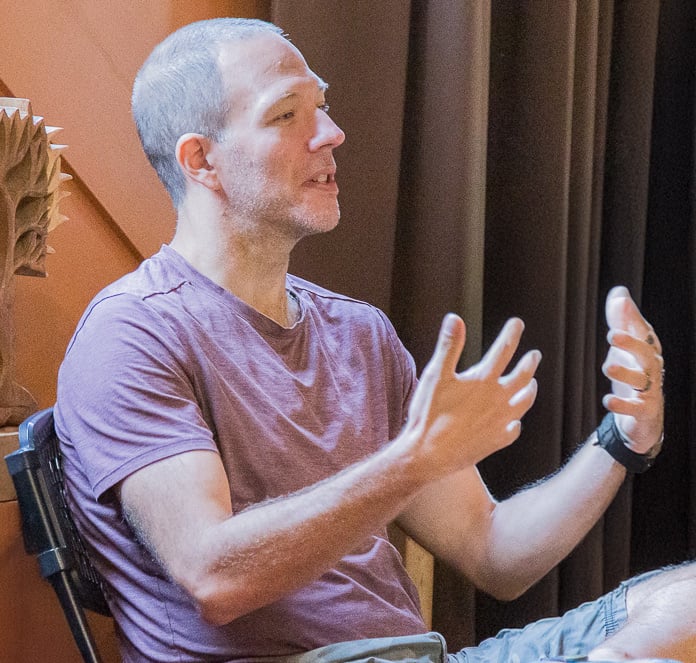
Jason Lange is a men's embodiment coach, group facilitator, certified No More Mr. Nice Guy coach, and evolutionary guide. He is the founder of Evolutionary Men, where he leads the Pillars of Presence coaching program, co-facilitates The Heart of Shadow shadow work retreat with Dr. Luke Adler, and hosts the Evolutionary Men Podcast. Jason has been sitting in men's groups for over 20 years, has been part of multiple groups simultaneously throughout that time, and has facilitated hundreds of men's groups through the Men's Group Experience program. His training lineage includes John Wineland, Dr. Robert Glover, Jun Po Roshi, Tripp Lanier, Ken Wilber, Brother David Steindl-Rast, and Robert Augustus Masters. He is a Stages International Certified Debriefer. As Dr. Robert Glover says: "Keep an eye on Jason Lange. You are going to start seeing his name more and more in the world of men's work."
READY TO STOP DOING THIS ALONE?
Don't wait for the crisis. The most effective men in the world surround themselves with trustable, kind-hearted men who give them support when they need it and accountability when they need it. If you're ready, explore the Men's Group Experience.
Or listen to the Evolutionary Men Podcast to hear what this work sounds like.